Walk the Building
This courthouse is not a container for history — it is history, told in stone. Every floor records who the federal government let inside, what happened to people when they entered, and how one man the establishment called dangerous learned to work its machinery and then left his name over the door. Start on the sidewalk. Look up.
Read it for one question, the question Gus Solomon spent his life on: is an institution a gate that keeps people out, or a machine that can be made to serve them?
- 1Outside · SW Main Street
The Steps
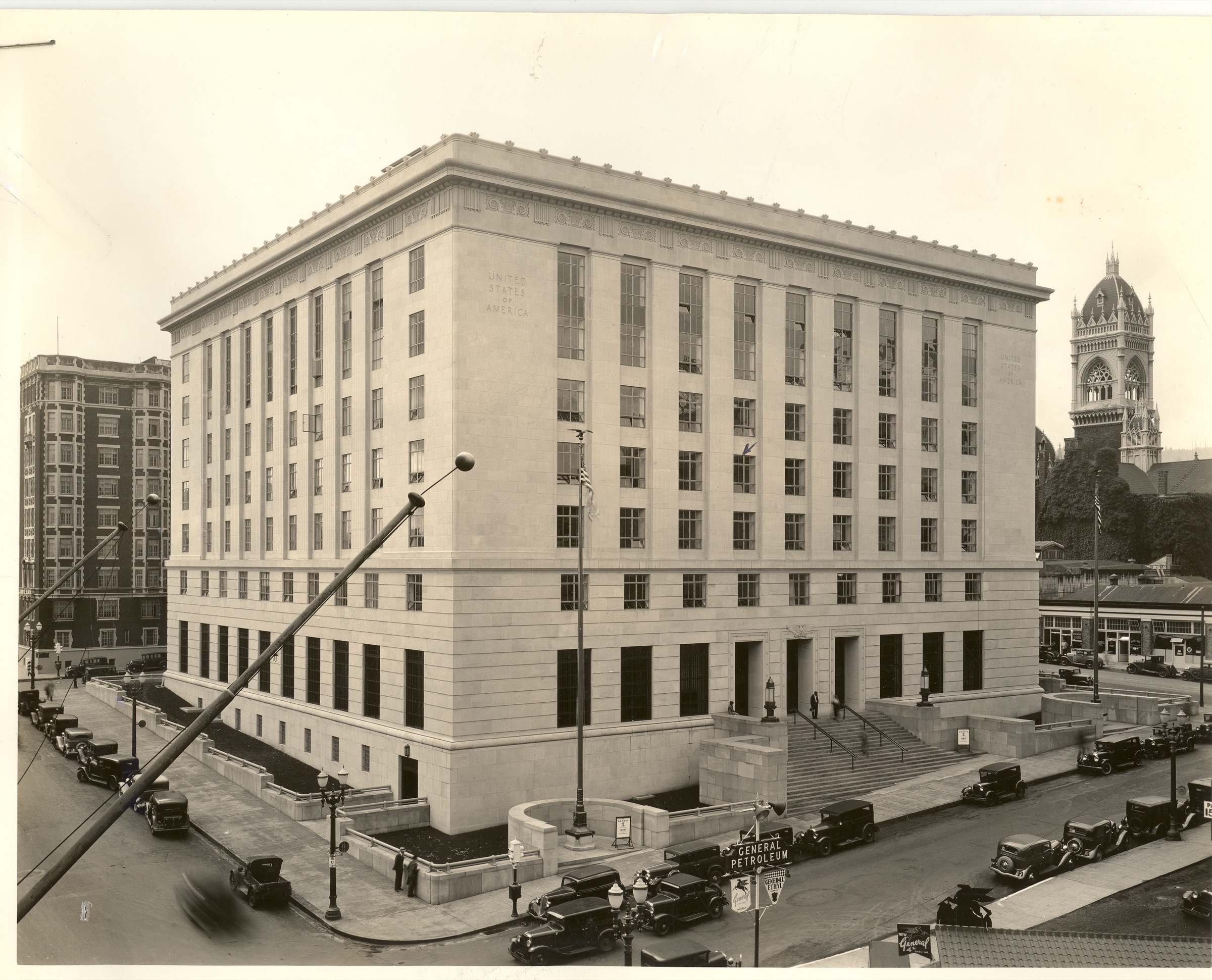
Public Buildings Service, National Archives (via the Federal Judicial Center) Before you go in, notice what the building asks you to do. It makes you climb. Twenty-four granite steps lift you off Main Street to a wall of bronze doors, and above them a stone eagle with its wings spread. The sandstone is Wilkeson gray over a frame of steel and concrete; the Doric pilasters and the deep cornice all say the same word — permanence. When the doors opened on September 25, 1933, the marble inside still shone and the stone had not yet stained.
Here is the turn to hold in your mind as you climb. In 1933, Gus Solomon was not a judge. He was a struggling twenty-seven-year-old lawyer whose work for labor unions, civil liberties, and public power had convinced much of Portland's establishment that he was dangerous — a radical, very nearly a Communist. The court that would one day sit inside this building would say so out loud, and nearly keep him off the bench for it. The building he would eventually run was rising before he had any power at all. An institution can exclude a man, and then be remade by him. Keep climbing.
- 2First floor
The Foyer
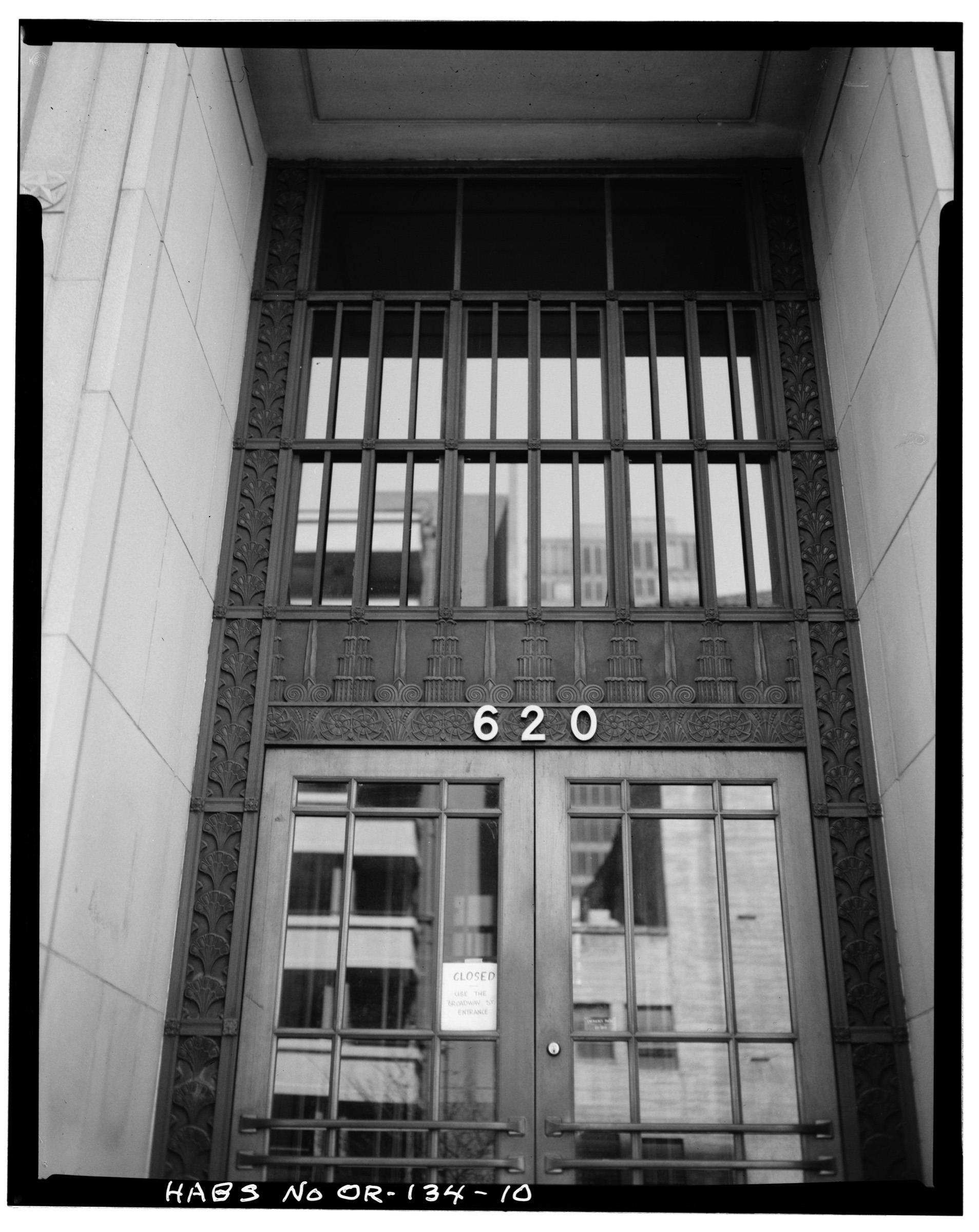
Historic American Buildings Survey (HABS OR-134), Library of Congress Look down before you look up. The floor is Brown Nebo Golden Travis marble, and the gold in its veins is real — a 1932 Oregonian reporter went almost giddy describing stone that a Treasury engineer said held gold too tightly bound to extract. This is what federal permanence looked like when it was poured, in the worst year of the Depression, into a building where hundreds of men were glad of the work.
On the end walls, bas-relief figures honor the Oregonians who died in the First World War. Stand with them for a moment, because they mark one of Solomon's contradictions. He was a civil libertarian and a patriot at once. He supported the draft — not out of militarism, but because as a boy during that war he had watched men shamed in the street for not enlisting, and decided a fair, rational draft was better than a mob deciding who was a coward. His politics were never government-is-good or government-is-bad. They asked one thing: is public power being used rationally, and fairly?
- 3First floor
The Postal Lobby
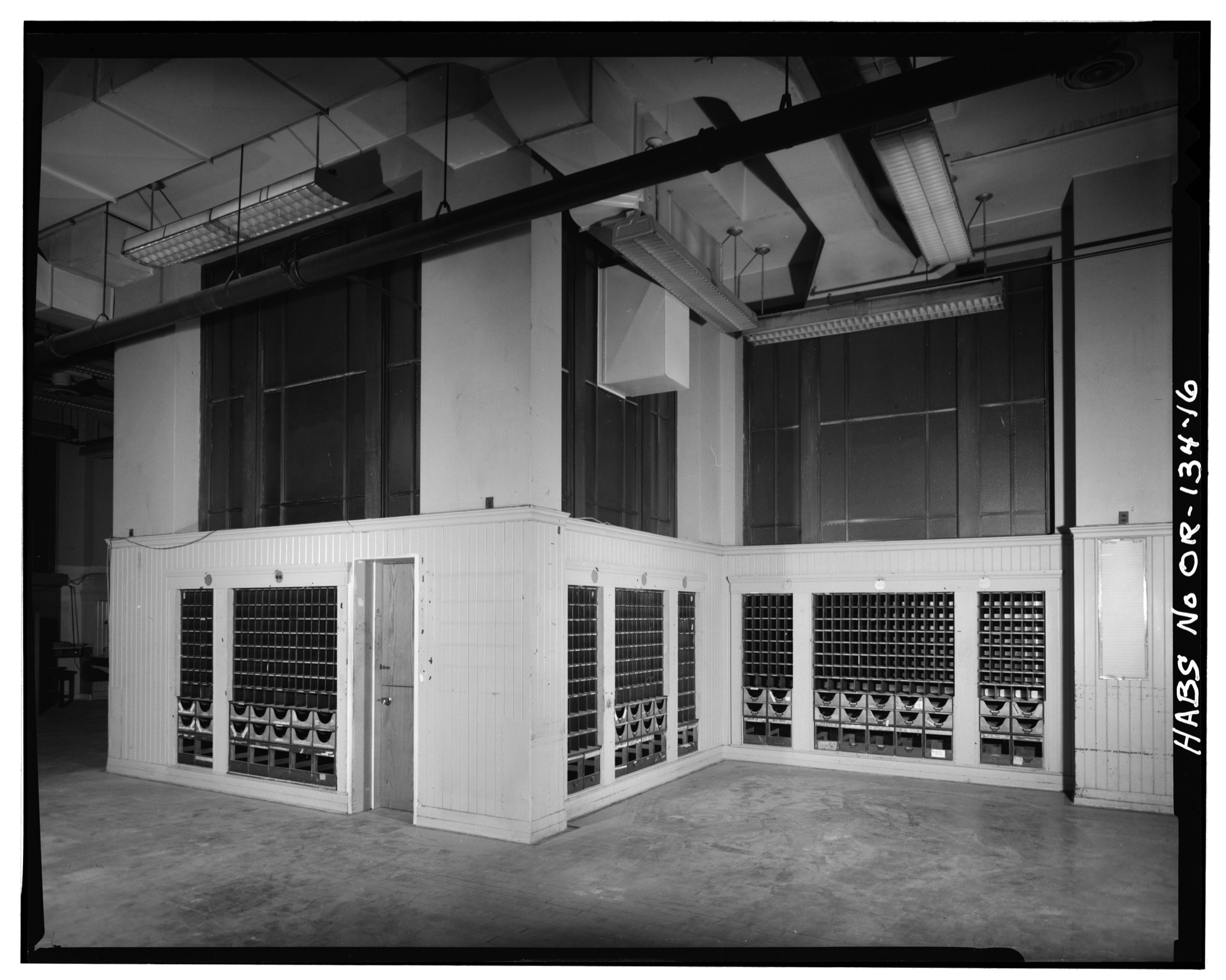
Historic American Buildings Survey (HABS OR-134), Library of Congress For most Portlanders, this was not the place where constitutional law got made. It was where you mailed a letter. The whole first floor was a post office — a long marble hall of bronze writing desks and lockboxes, wall clocks, signage lettered on black glass, and turquoise ceramic ash receptacles set into the stone.
Hold onto that doubleness. Six floors up, the sovereign state was oak and Corinthian columns; down here it sold you stamps. The building was a palace and a public utility in the same block — which is very close to how Solomon understood government itself. Not an abstraction to revere or resent, but machinery, to be judged by one test: whether it actually served the ordinary people who walked in the door.
- 4Rising
The Light Court
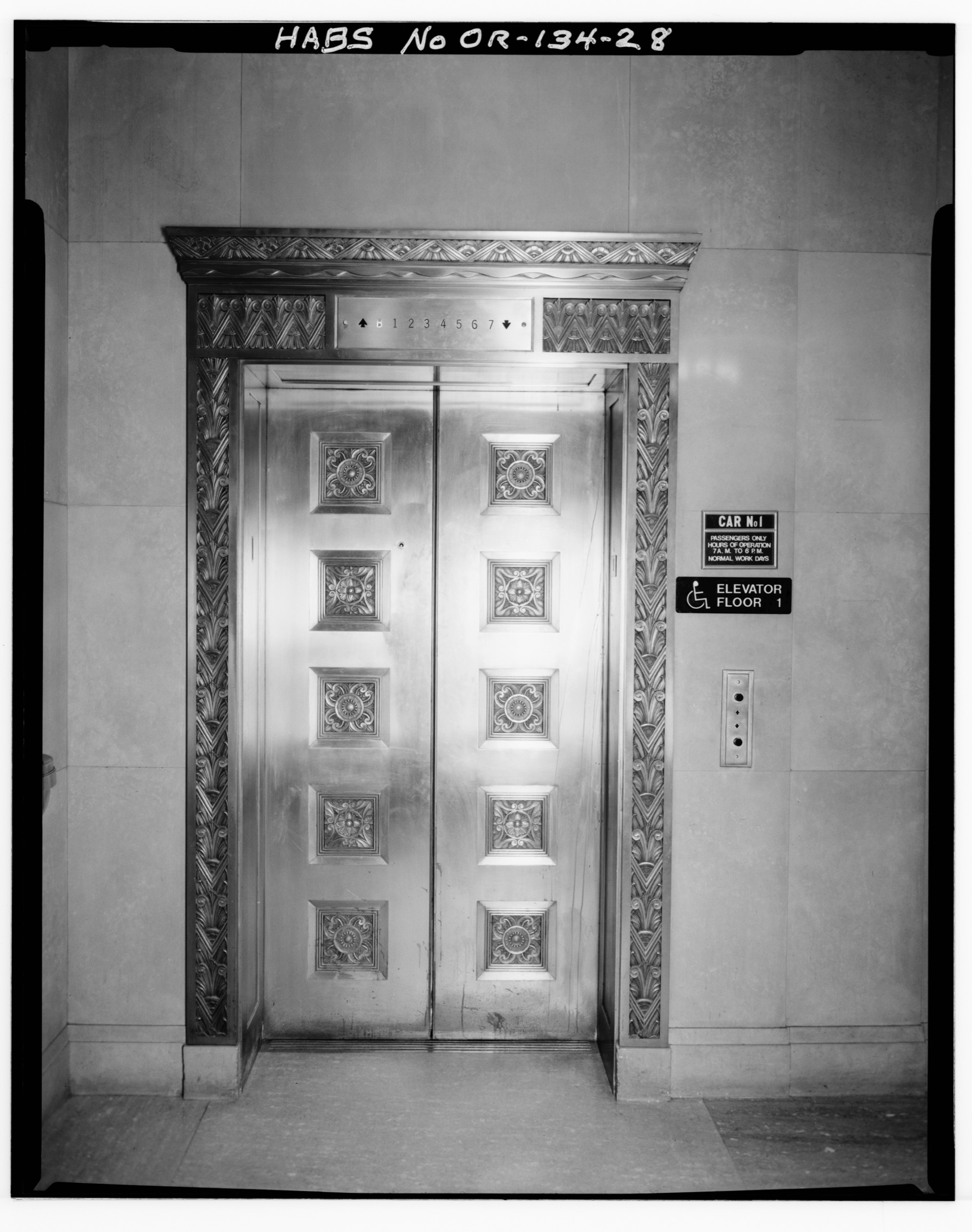
Historic American Buildings Survey (HABS OR-134), Library of Congress The building is a quiet trick of geometry. Only the first floor fills the whole two-hundred-foot block. Above it, the courthouse becomes a hollow square wrapped around an open light court, sixty-five feet by seventy-eight. As you rise toward the judges, the building reorganizes itself around a column of empty air.
Ride up past the floors that once held the rest of the federal state — the recruiters and the Coast Guard, the Forest Service, the tax collectors, the immigration examiners, the marshals — and past the thousands of hours of clerical labor that made a judge's day possible. The great men got the marble and the bronze. The government, most of the time, was the clerks.
- 5Sixth floor
The Courtroom
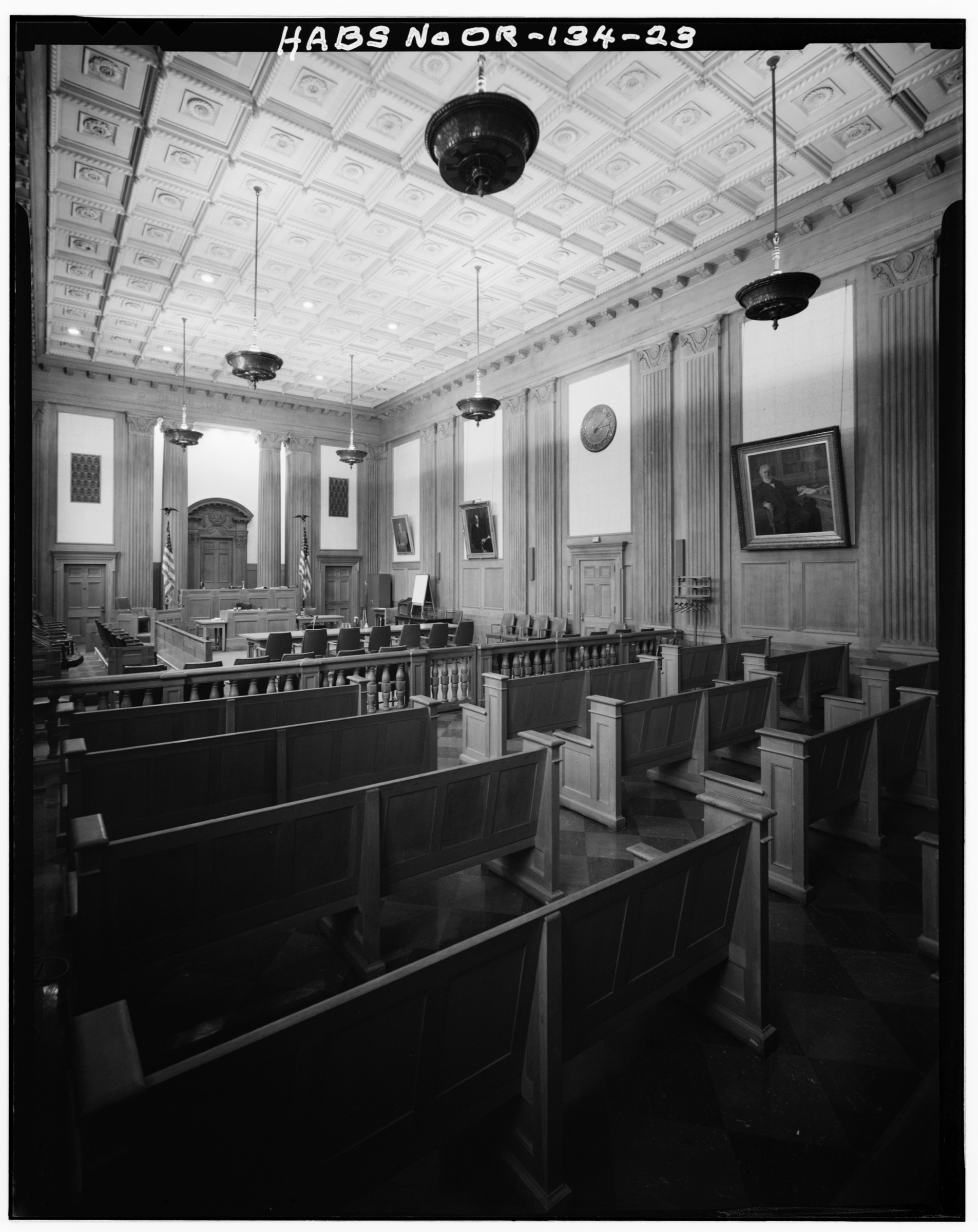
Historic American Buildings Survey (HABS OR-134), Library of Congress Stop, and take the room in before a word is said. Twenty-four feet and four inches to the coffered ceiling; oak walls; leather-covered doors; Brown Nebo marble; and paired oak Corinthian columns rising around the bench. Every choice was made to tell whoever entered that the law was older, steadier, and larger than he was.
On June 12, 1942, a twenty-five-year-old Oregon-born lawyer named Minoru Yasui stood in one of these courtrooms and made the law answer for itself. Six months after Pearl Harbor, he had deliberately walked downtown Portland after the curfew that had been clamped on everyone of Japanese ancestry, and then turned himself in — a trained attorney manufacturing a test case. He waived a jury and stood before District Judge James Alger Fee, his lawyer Earl Bernard beside him and U.S. Attorney Carl Donaugh across the aisle.
Among the friends of the court invited to brief the constitutional questions was a young Portland lawyer named Gus Solomon. The national ACLU had refused the case — a man who had once clerked at a Japanese consulate struck its leaders as too unsympathetic to defend. Solomon had written the ACLU's director, Roger Baldwin, pressing them to take it; when they would not, he went in on his own, the lone amicus arguing that the curfew was unconstitutional. Across the same room sat another friend of the court, arguing the opposite: Earl Warren, then Attorney General of California, and later the Chief Justice of the United States who would write Brown v. Board of Education.
Fee's ruling was a strange half-thing. The curfew, he wrote, could not lawfully bind an American citizen — but Yasui had thrown away his citizenship by working for the consulate, and so, as a foreign national, he was guilty. Yasui served nine months in a six-by-eight-foot windowless cell before the Supreme Court restored his citizenship, upheld the curfew against citizens, and sent the case back down. His conviction stood on the books for forty-two years. It was not vacated until 1984.
The line to carry up the next flight is this: before the building bore Gus Solomon's name, he stood inside it as an unimportant lawyer, telling far more important men that the government of the United States was wrong.
Which of the sixth-floor courtrooms? The records we have found do not say. Both of the building's original district courtrooms are on this floor, and the trial was almost certainly held in one of them — but no document we located names the room. A history worth trusting tells you what it can prove and marks the rest.
- 6Sixth floor · Room 615
The Chambers
Behind the courtroom is a door the public rarely passes. On its far side is where the power actually lived.
When Solomon joined this court in 1950 — the first Jewish federal judge in Oregon, confirmed only after a bruising fight in which opponents red-baited him and said plainly that Oregonians did not want a Jew on the federal bench — no one handed him a grand suite. For his first year he had no courtroom at all. He worked out of a commissioner's room with his secretary at the same desk, and was refused a law clerk because the chief judge had once gone without one. It took visiting appellate judges, appalled at the arrangement, to intervene.
By the end of his career he was here, in Room 615. On Friday afternoons he carried home the files for Monday's calendar — a hundred cases, sometimes a hundred and fifty — and by Sunday night he had read every one. A lawyer would rise on Monday to ask for more time to locate a witness; Solomon would ask which witness, and then tell him that was not what his own file said. Lawyers learned that he knew their cases better than they did.
The room was not only work. His judicial assistant remembered lunches here for the other federal judges, Solomon's wife Libby carrying in homemade matzo-ball soup while the clerks set the tables and washed the dishes afterward. Hold both pictures at once: Sunday night, one man alone with the hundred-and-thirty-seventh file; and a weekday noon, the federal bench of Oregon eating Libby's soup in chambers. The boy from South Portland who had been called a “Christ killer” on his way to Hebrew school now hosted the judiciary over his wife's cooking — a truer monument than the name cut into the stone downstairs.
One of the young men who sat in this chambers, as Solomon's very first law clerk, was Jerome Kohlberg. He went east, joined a Wall Street firm, and helped invent the leveraged buyout. The first “K” in KKR learned the law in this room.
- 7Sixth floor
The Anteroom
Between the chambers and the courtroom is a small room Solomon had to walk through to reach the bench. A judge friend in New York once told him that before imposing a long sentence he would prick himself with a pin, to remember that he, too, bled. Solomon liked the idea and hated the pin.
So he hung a painting in this room instead — a Gandy Brodie, a funeral candelabrum rendered in shades of black, the painter's image of death. On the mornings he was to sentence someone, he made himself look at it on the way to court, he said, “to remember that I'm human, too, and that I'm going out to send human beings to the penitentiary.”
He was not soft about it. Repeat violent offenders, he believed, sometimes belonged in prison, and he accepted the duty of putting them there. His humanism was never the idea that nothing is anyone's fault. It was something harder: never let yourself forget what you are doing to another human being.
We have not yet located the painting itself. The Gandy Brodie estate holds a 1972 portrait titled “Judge Solomon,” studies from the 1950s, and photographs of the two men together — but the sentencing-day candelabrum, and where it hangs today, are still being traced.
- 8Seventh floor
The Appeals Courtroom
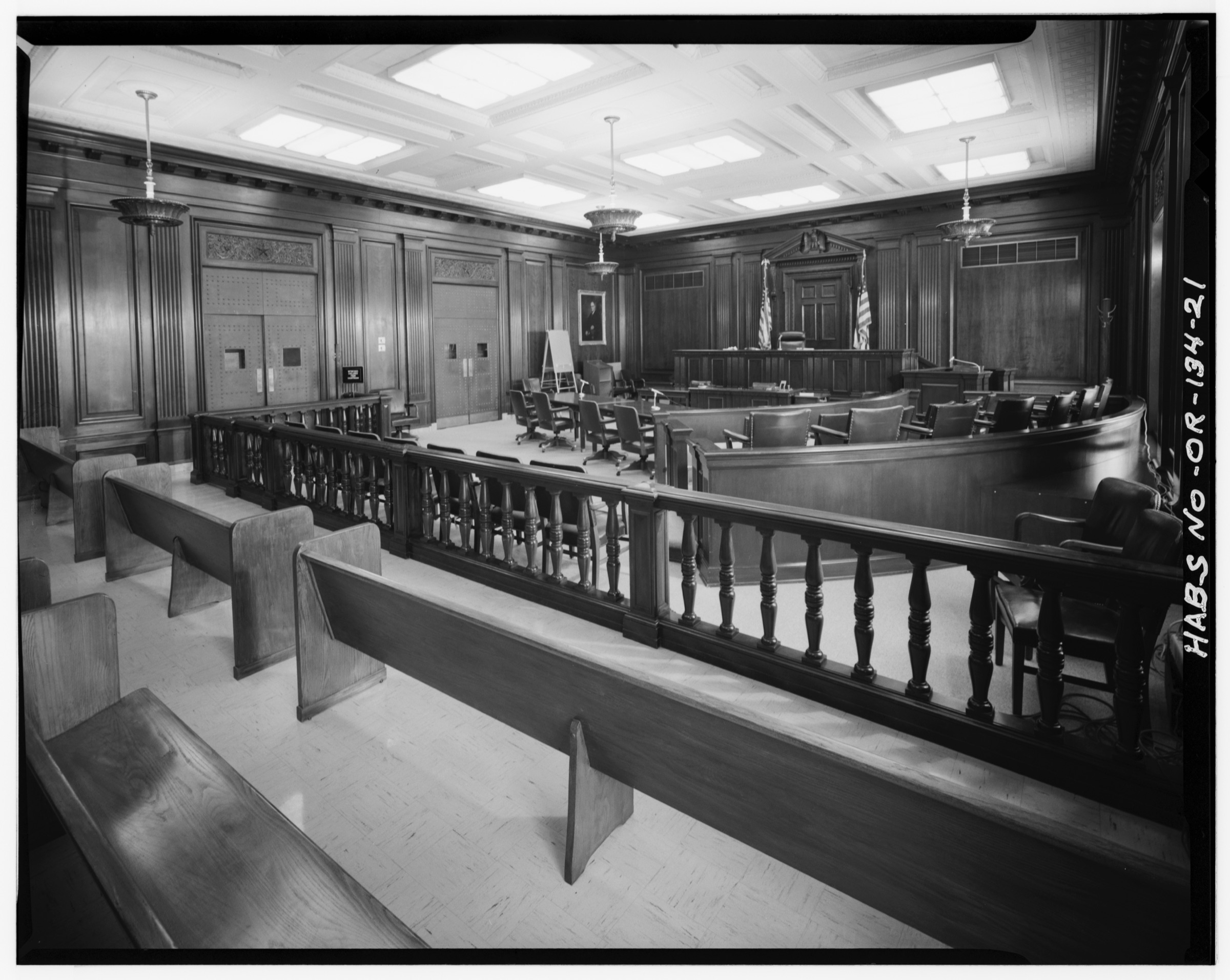
Historic American Buildings Survey (HABS OR-134), Library of Congress One floor up, the vocabulary softens — cherry instead of oak, a lower coffered ceiling, a curved jury box. This was the appeals court's room, and it is the right place to meet the other Solomon: not the civil libertarian, but the systems engineer.
His obsession was not grand legal theory. It was waste — the ten weeks spent on what three days could settle. In Weyerhaeuser Co. v. Combustion Equipment Associates, a document-buried industrial case he judged would take six weeks to try in any other court, he forced the parties to fix the evidence in advance: a single 173-page pretrial order that folded in twenty-six depositions and seventy-one written witness statements, so that by the time the trial opened the fight had already been narrowed to what was genuinely disputed. He tried the whole case, without a jury, in about two and a half days. The Ninth Circuit affirmed, and around the federal courts they took to calling him the Fastest Gavel in the West.
The building itself explains the method. The spectacle happened in the courtroom; the work happened behind the chambers door. Solomon's cases moved fast in public because he had moved the thinking upstream, into the quiet room where no one was watching. Speed, for him, was never haste. It was a refusal to waste other people's time — the same instinct that made him despise a firm that would not hire a Jew, or a club that shut people out of the lunches where the real business of the city got done.
- 9Back on the street
The Building Between Lives
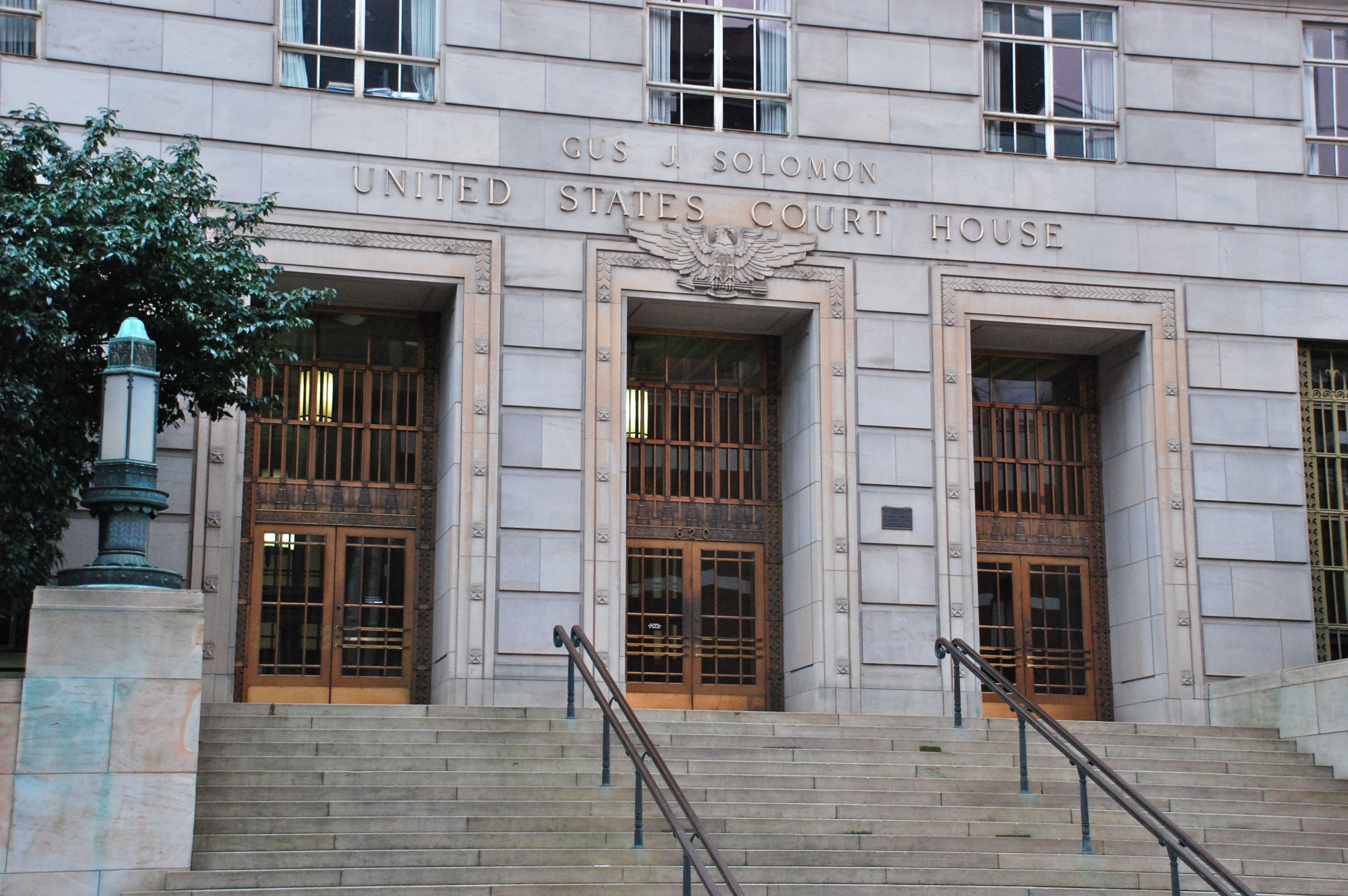
Steve Morgan, CC BY-SA 3.0 (Wikimedia Commons) Congress cut his name over the door on October 28, 1988, the year after he died. In 1997 the district court moved out, two blocks west to the newer Hatfield Courthouse, and for a while the great rooms went quiet.
In 2025 the federal government sold the building. That December a Portland firm, SKB, bought it; in April 2026 the first construction permit went in for offices in the old postal hall on the first floor; and that summer Portland Civic Lab moved in as the first tenant of the building's next life.
So this is not a dead building. It is a building between lives, and standing again on the steps you are left with the question it has asked from the beginning — whether an institution is a gate that keeps people out or a machine that can be made to serve them. Gus Solomon spent his life on the second answer. He climbed these steps as a man his city called dangerous, and he left his name on a courthouse he had helped pry open. What happens inside it next belongs to whoever climbs the steps now.
The cases named on this walk — and the ones that didn't fit — are laid out in full, with citations and what the record does and doesn't prove, in Trials of the Courthouse. The man himself is in his biography.